
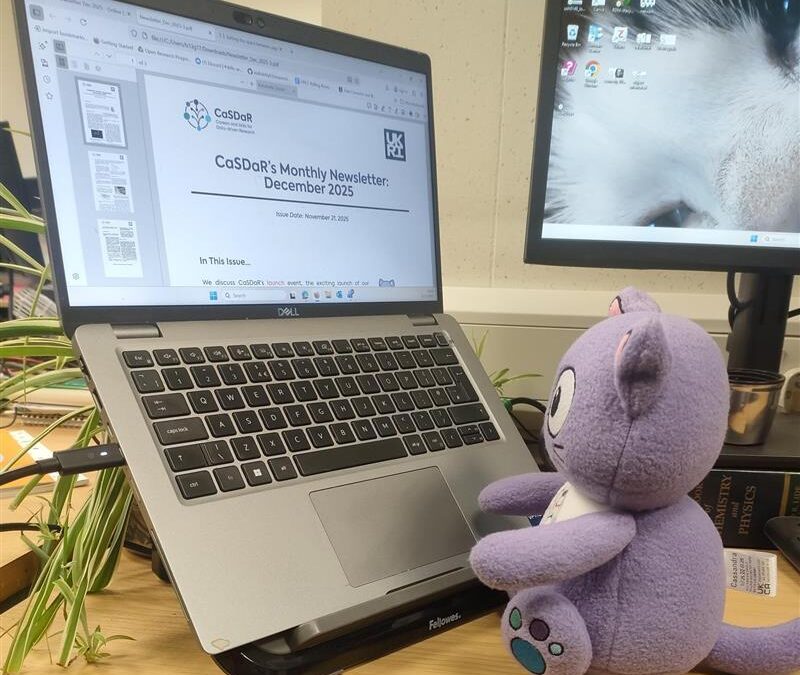
A PDF of this newsletter can be downloaded here.
In this Issue
In our March newsletter, we discuss our upcoming AMA with Cassie, keep you up to date on our funding call, talk about our work with other networks, reflect on our Trusted Research webinar and talk about our future events.
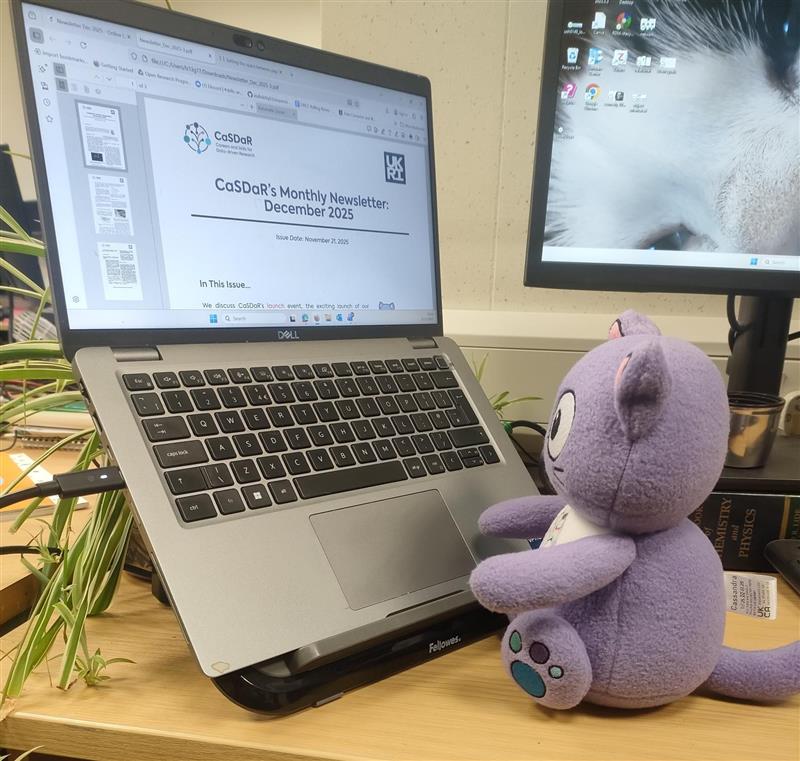
Come and meet Cassie at our AMA (Ask Me Anything)
On Friday, 17 April 2026, Cassie and the CaSDaR Co-Is will be hanging out on our Discord server 09.00-17.00 BST (because maintaining a healthy work–life balance is important, especially for everyone’s favourite Data Steward!) and she’ll be ready to answer all your questions.
- Curious about her work?
- Want to know her favourite food?
- Wondering what life as a Data Steward is really like?
- Want to discuss her desk ergonomics?
- Just want to talk data… or say hi?
Drop into the Discord and ask Cassie anything! Use this link to join the server and come along to our AMA!
Announcing the successful applications from CaSDaR’s first funding call
CaSDaR launched our first funding call in November 2025, with applications closing on the 22nd January 2026. Our reviewers had a month to review the applications, before our review panels for the £5k funding stream and £70k funding stream met on the 5th March 2026.
The quality of the applications we received was incredible and we did not know how we would be able to decide on only funding a few of those applications.
For our £5k funding call, we received 5 applications, entirely from Higher Education Institutions. The role title of the primary applicants varied, with lecturers, librarians, and PRISMs submitting applications. We decided that we would be able to fund all applications:
- ‘Applying FAIR data principles to unlock the value of historic datasets at the UK Vegetable Genebank’ by Sarah Trinder;
- ‘The Springboard Project: Data Stewardship & Open Research Repository at Queen’s University Belfast’ by Michael O’Connor;
- ‘A Structured Approach to Laboratory Sample Inventory and Metadata Stewardship’ by Susana Sauret Gueto;
- ‘Piloting the role of Data Stewards in Fetal Alcohol Spectrum Disorders (FASD) within Justice Settings’ by David Gilbert; and
- ‘Supporting the development of a community metadata standard: Consolidating and extending IRIS’ by Cylcia Bolibaugh.
The £70k funding was more competitive; we received 24 applications and, though we had initially proposed that we would fund three applications, we decided that we should fund four projects given the high quality of applications submitted. These applications came from primarily Higher Education Institutions (70\%), with non-profit companies and Trusted Research Environments also submitting relatively lower numbers of applications. In line with this, most applications listed lecturers or research associates as the primary applicants, with individuals with the title of ‘Data Steward’ as primary applicants on half of the number of applications of their academic counterparts.
The projects varied greatly in the approaches that they took; many applications were seeking to embed Data Stewards into projects and show the value of this through a narrative approach, whereas some were applying metrics to retrospectively analyse the impact of Stewardship. Others were seeking to create communities and training to promote good practice and identify barriers. The successful £70k projects are below:
- ‘Evidencing the impact of data stewardship roles using administrative and scientometrics data’ by Noam Tal-Perry and Clair Castle;
- ‘Sustainable Data Stewardship: Building Continuity, Capacity, and Recognition in Temporary Research Environments’ by Duygu Dikicioglu;
- ‘FRAME-DS: Framework for Recognising Applied Data Stewardship Within TRE Workforces – A Collaborative, Cross-Organisation Pilot’ by Linus Chirchir and Rosie Seaman; and
- ‘IMFAIR: Isle of May FAIR and AI‑Ready Data Stewardship for Long‑Term Seabird Monitoring’ by Deena Mobbs and David Leaver.
We are incredibly excited to see what comes out of these projects, and we’re already looking forward to the next funding call!
Working with other networks
CaSDaR is keen to work with other networks across the research landscape, as we’ve described in previous newsletters. We have ongoing collaborations with groups such as STEP-UP, the UCL Office for Open Science and Scholarship, theUniversity of Sheffield Library, and the DIRECT framework. We’re looking to expand the network to ensure that we create an inclusive and representative space.
We’re always looking to broaden our networks, so please get in touch with us via casdar@soton.ac.uk if you would like to work with us!
Reflecting on our Trusted Research webinar
Trusted Research is an initiative that supports the appropriate sharing of open data whilst also acknowledging the requirements to safeguard sensitive data and research from potential misuse by bad actors, protecting the essential collaborations that support international research. Aligned with Trusted Research are the key principles of export control, which support the proportional sharing of sensitive data, raise awareness of appropriate licensing, and ensuring the necessary requirements to maintain control of data.
As key facilitators of research, Librarians and Data Stewards are often the people at institutions who support researchers in making their data open and usable for international collaborators, and ensuring that global data collection and sharing occurs in the correct legal and ethical frameworks. So when Lara Skelly at the University of Loughborough asked for people to work with to deliver a webinar on Trusted Research for Librarians/Stewards, alongside representatives from HERSA and folk from the National Protective Security Agency (NPSA), we jumped at the chance.
The webinar we ran on the 26th February 2026 sold out within 2 hours, so we increased ticket capacity, and tickets sold out again. Unfortunately, we couldn’t record the webinar or create a summary. However, the webinar was so well received that we’re planning more work with these groups for the next few months, to seek advice from the librarian and Data Steward community to curate resources from these groups’ existing catalogues which support the key work that these Research Professionals do.
Cassie’s Corner

Recently, Cassie has been thinking about the importance of Data Retention and Deletion Policies. They are key to ensuring that data that is stored by an institution properly, but also to promote a proportional view towards data retention vs. deletion. Data cannot be retained indefinitely and ultimately decisions need to be made about when it is appropriate to delete data or to seek alternative storage measures.
There are areas that need to be considered when thinking about data deletion: data retention periods, GDPR and linked legal frameworks that can inform decisions about data deletion, and ensuring that a method is used that is appropriate for the disposal of that data.
Cassie thinks that considering data deletion is a key part of Data Management Planning, so would love to see that all institutions and organisations have a Data Deletion and Retention Policy.
Future Events
We’re very excited to announce some upcoming events, from us, project partners, and others that are relevant to the CaSDaR community:
- CaSDaR, in collaboration with the Research Data Alliance’s Data Steward Careers Track Working Group, the University of Sheffield Library, STEP-UP, and the UCL Office for Open Scholarship is bringing together people across the sector to co-create data steward personas. We are offering two hybrid events; one at the University of Sheffield on the 14th April 2026 and another at UCL on the 22nd April 2026, as part of the London Open Science and Scholarship Festival 2026. Bursaries are available for in-person attendance, and both events are offered as hybrid sessions. You can register for the in-person and online events on the 22nd April 2026 and for in-person and online tickets for the event on the 14th April 2026;
- The UK Data Service (UKDS) provides training for anyone looking to gain access to data in their repository. This session will be on 8th April 2026, 10.00-13.00, and more information is available here;
- The STEP-UP group are a regional network looking to promote the roles and skills that dRTPs bring to enrich research quality. They have organised a conference for the 29th June 2026, and are accepting abstracts for talks on data, software, or infrastructure with a deadline of the 14th April 2026. More information can be found here; and
- The London Open Science and Scholarship Festival is happening from the 20th-24th April 2026. This week long hybrid event seeks to bring people together to consider subjects aligned to Open Science. Topics covered over the week include: Open Research and Gender, Data Steward Personas, Funder perspectives amongst others. More information and tickets are available from this site.
About CaSDaR
The Careers and Skills for Data driven Research (CaSDaR) initiative is a 4-year UKRI funded project which aims to address this gap by helping to define the role of Data Stewards within the UK research landscape and advocating for their recognition and representation across institutions.
We plan to complete these goals by connecting existing networks that support and elevate Data Stewardship in the UK, coordinate with international networks to ensure that activities for Data Stewards in the UK remains in line with global progress in this area, and to provide funding for case studies that demonstrate the crucial role that Data Stewards play in the continued development of the UK research ecosystem.
If you would like to hear more then please check our website, join the CaSDaR mailing list to keep up to date, follow us on LinkedIn, and email casdar@soton.ac.uk for more details.