
A PDF of this newsletter can be downloaded here.
In this Issue
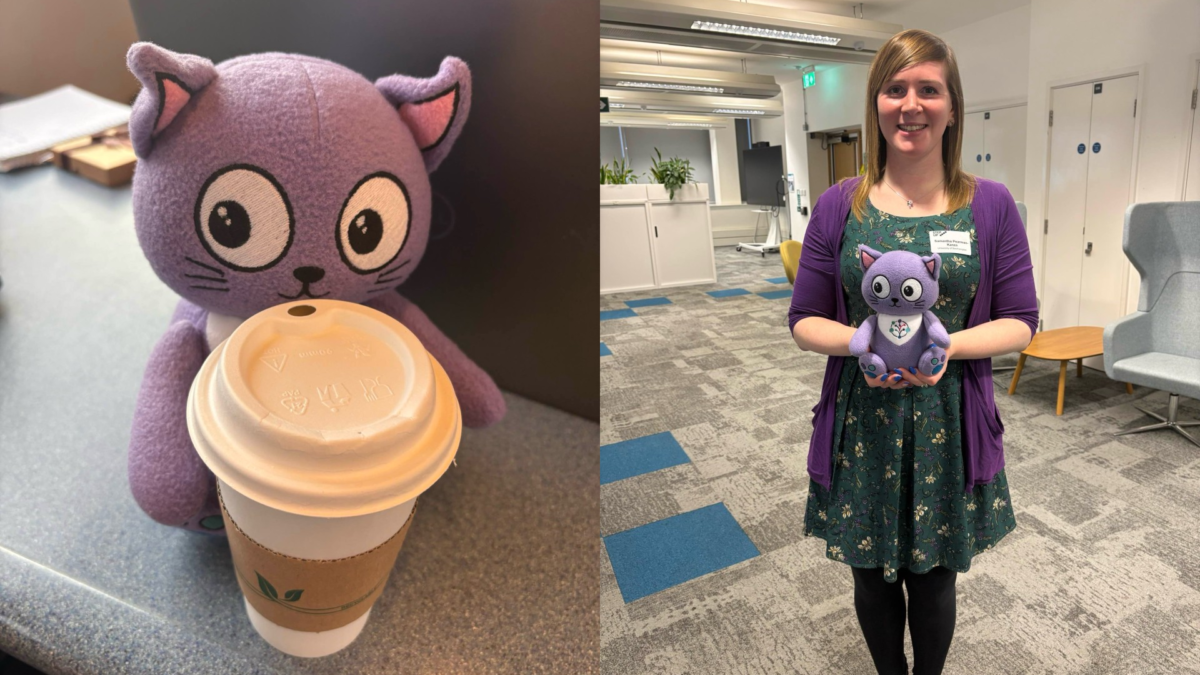
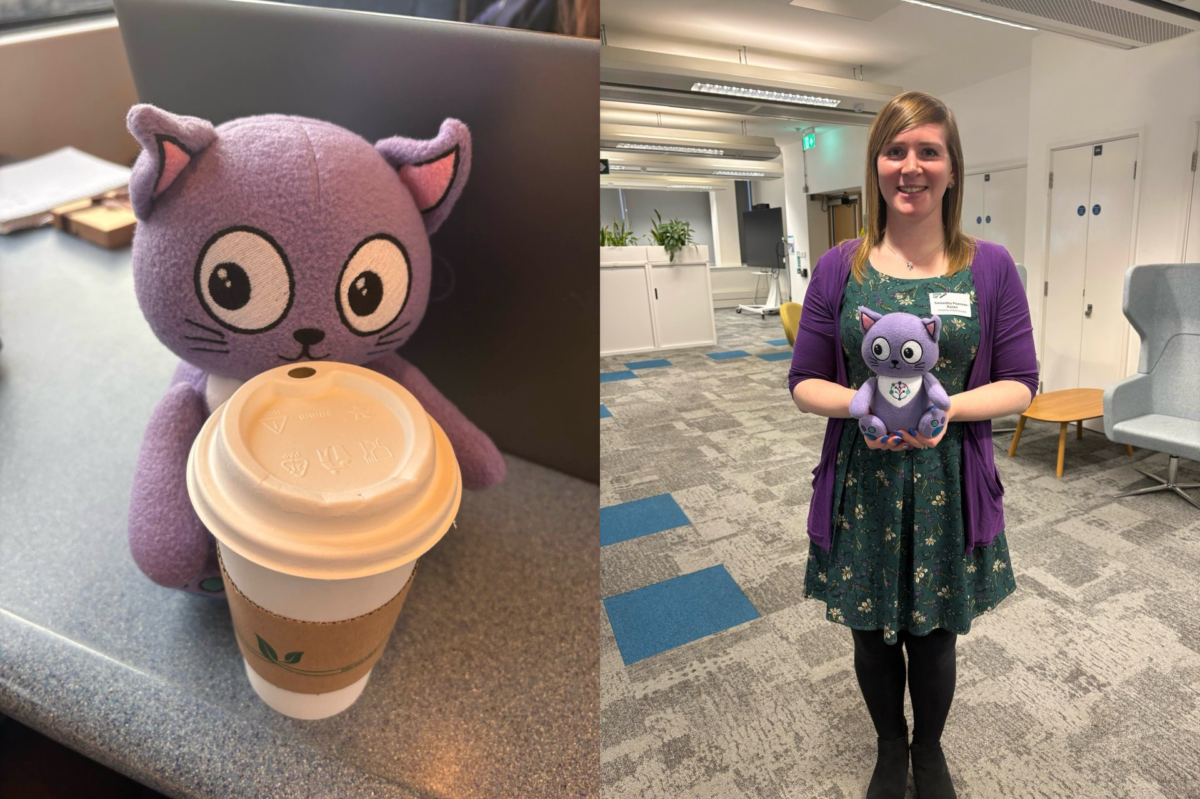
We discuss the process for reviewer allocation for the funding call, talk about Cassie’s recent adventures (where we acted as the travel companion to chaperone her), talk about International Love Data Week 2026 and let you know about our upcoming future events.
Launching our first webinar series
On the 12th December 2026 we launched our first Data Steward Stories webinar, with Dr. James Steele presenting his career to date. Again, we were so happy with the community’s engagement as over 30 people turned up to listen to James’ talk and to ask questions.
James has previously worked with CaSDaR members and with our project partners, the UK Reproducibility Network, but the breadth of his work still surprised us. In his typical engaging and approachable way, James took us through his career to date. Whilst he frequently stated that he has been ‘lucky’ throughout his career, it became clear that James has worked hard for his success and has always made the most of opportunities presented to him. Even when there were bumps in the road, such as projects being shutdown due to the COVID-19 pandemic or being made redundant, James continued to work with integrity and championed practices that he believed in.
A recording of the session is available here and a report, including the questions, is available here. We will have another Data Steward Stories session in early March 2026, so we look forward to seeing everyone there!
International Love Data Week 2026
Since 2016, International Love Data Week has occurred as an annual themed series of events. Whilst there is a Love Data Week panel, interested parties are encouraged to organise local events with the suggested theme of that year’s event. The theme for 2026 is: ‘Where is the data?’
We’ve collated some events that members of our community have organised and we’re pleased to share them here:
- The UK Data Service (UKDS) is running an event ‘Perspectives on Engagement and Impact: a UK Data Service event for Early Career Researchers’ on the 11th February 2026, 10.00-15.00 GMT. This free in-person event, held in The Engine Room at the People’s History Museum in Manchester, will support ECRs to develop their skills in communicating their research for translation into policy. This workshop offers practical tools and inspiring perspectives to help you take the next step, with attendance from stakeholders interested in policy engagement. Through sessions such as ‘Stakeholder Speed-Dating’, Panel Discussions, and Lightning Keynotes, this interactive workshop looks like a great opportunity for ECRs to learn how to translate their data into impact through policy. Find out more and register here. This promises to be an exciting event covering the importance of stakeholder engagement with research data;
- The University of Southampton Research Data team have organised a range of fantastic online events for this year’s International Love Data Week. On the 10th February, 13.00-14.00 GMT Matt Spitz Mahon will discuss Petabyte Scale Data Storage at the University of Glasgow on the 12th February, 12.00-13.00 GMT, Jen Gibson from Dryad will present on Credibility, integrity and intent in research: The role of research data, then on the 13th February, 12.00-13.00 GMT Matt Phillips will talk about Discovering Collections as Data at the University of Southampton Library. The active links in the descriptions are for registering for these events, which look like a highly relevant set of talks that will no doubt be of huge interest to the CaSDaR community;
- Words that we frequently hear from our community about data are ‘love’ and ‘care’, so we were pleased to see them mentioned at this event organised by Research Data Oxford, where the Research Data Management (RDM) services from the University of Oxford will be on hand for anyone wanting to learn more about how the University provides love and care for its valuable data collections. Alongside this, several external organisations such as TRESS -Trusted Research Environments Software Stewardship and CaSDaR (!) will be attending to present work in their respective projects. See here for more information.
These events all look brilliant and we’re so happy to share them widely with our community.
Recognition of our Principal Investigator’s work
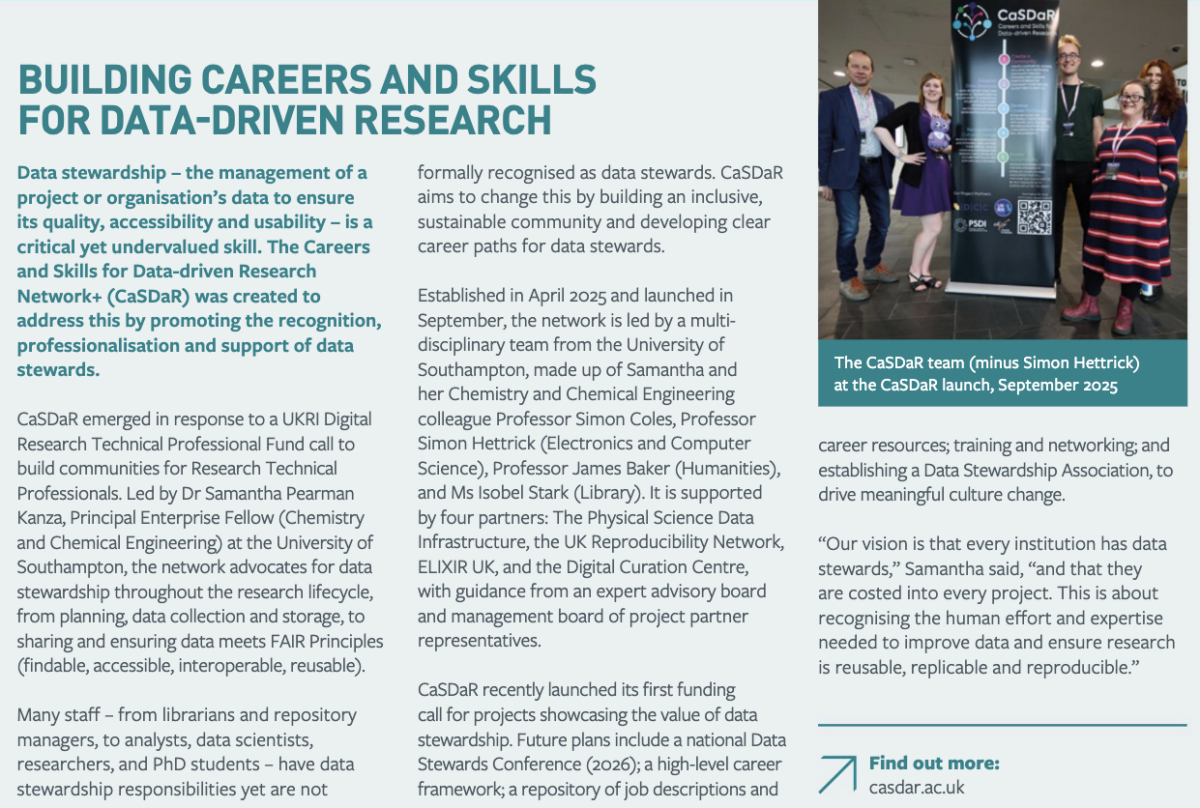
The University of Southampton has a magazine called Re:Action that summarises the research and enterprise activities at the organisation. The winter issue of Re:Action had a focus on the initiatives and individuals that are helping create an environment where people can thrive: from addressing promotion inequalities amongst different groups, to increasing engagement among doctoral students, to enhancing recognition of research technical professionals.
They approached CaSDaR’s Principal Investigator, Dr. Samantha Pearman-Kanza to see if she might be interested in talking about the development of the CaSDaR project, which is targeted towards developing reward and recognition for Data Stewards. Sami gave an excellent overview of why CaSDaR was developed and what we want to achieve. Furthermore, it’s brilliant that the work of Sami and the team is getting recognised like this by the organisation.
You can read the story here, on page 30.
Working with other networks
CaSDaR was funded by the UKRI as part of their dRTP funding call to promote the work of individuals who work in the UK research sector to encourage good digital research practices. Also funded in this call were the networks SCALE-UP, DisCouRSE, CHARTED, and Computational Abilities Knowledge Exchange (CAKE).
Over the last few months we’ve been delighted to attend excellent workshops and events run by these and other networks, such as SCI, Computation and Data in Research (CaDiR), and ELIXIR-UK RDM club:
- In September, Sami presented at the ELIXIR-UK RDM club on the aims of CaSDaR;
- In October, Louise discussed the work of CaSDaR at the UKRI DRI Congress in a session organised by CAKE;
- Also in October, at the Lab Innovations conference, Sami gave a talk on the pitfalls on not taking care of our data;
- In November, Louise and Sami attended an event organised by the CHARTED, DisCouRSE, and SCALE-UP to understand the dRTP training landscape;
- At the beginning of December, Sami spoke about CaSDaR at a University of Manchester Research Data Conversations event organised by CaDiR;
- Also in December, Louise spoke at Computing Insight UK in Manchester to talk about CaSDaR in a network+ session and at a session organised by CAKE.
They’ve set a really high standard for us to live up to and we’re looking forward to working more with these and other networks in the future.
Progress on our funding call
When we launched our first funding call, we thought that one of the biggest requirements would be to think about reviewer recruitment.
Turned out, that was one of the smallest things to sort, and that’s because of YOU, our amazing community. So many of you came through to act as reviewers and we cannot thank you enough. We’re so grateful to you all for this and it reminds us why we’re doing this work.
We now had to think about how we allocated reviewers… We knew we wanted the allocation process to be random, excepting where there are conflicts of interest. Out of principle, we initially tried to re-use currently available open-source executables for reviewer allocation. However, due to their age, some libraries and packages had been updated/made obsolete which meant the poor CaSDaR team, under the watchful eye of Cassie, was desperately trying to find fixes as well as trying to understand the logic of the available script, ever aware of the ticking clock counting down to when the reviewer allocation process was scheduled to be decided. When one of Cassie’s software engineering friends pointed out that we were trying to re-use software on principle and believing in a sunk-cost fallacy, we admitted defeat and re-wrote the whole thing.
Apart from some hairy moments where a certain Network+ Coordinator forgot that 64 was *definitely* less than 72, then spent an embarrassingly long time wondering why no reviewers could be identified (Cassie was disappointed that they didn’t seem to understand the difference between strings and numbers), we finally had a working script that randomly allocated dummy applications to reviewers.

All we have to do now is wait until we receive all of our applications on the 22nd January 2026. We ran Q\&A webinars in December and January to support submissions, and we were so impressed with peoples’ comments and questions. The Data Stewardship work that the community is doing is of such a high-quality and we’re really excited to see what our community submits. The FAQs page is being frequently updated and recordings of the launch are available of CaSDaR’s YouTube channel.
Cassie’s Corner

This month, Cassie has been contemplating the role of documentation in data sharing, with a focus on the role of README files. Whilst these files are often associated with software releases, they could be useful for data. Cassie has personally found it useful to create README files for complex data types, such as aggregated data sets, and for multi-stage processing and analysis. It meant that if she had to look back at the data, all of the relevant information to help her contextualise that data is present. In her README files, she will include the version of the software that she’s used, the licenses involved, links to her ethical approval, and links to relevant data sets. Sometimes, Cassie has found it hard to keep her README files trim; it’s tempting to put everything in there! But she started to refine the purpose and scope of her README files before she wrote them. She found this resource especially useful in her learning journey.
Future Events
We’re very excited to announce some upcoming events, from us, project partners, and others that are relevant to the CaSDaR community:
Trusted Research supports the integrity of the system of international research collaboration, which is vital to the continued success of the UK’s research and innovation sector. In partnership with Loughborough University and CaSDAR, NPSA and HEECA are delivering this inaugural webinar as a fantastic opportunity to introduce trusted research (TR) and begin to touch on how you as repository and data managers already are or could be involved in TR as part of your work. This introductory training webinar ‘Trusted Research for Repository/Data Managers’ will be held on the 26th February 2026, 10.00-11.00 GMT. The link to register for the webinar is here.
About CaSDaR
The Careers and Skills for Data driven Research (CaSDaR) initiative is a 4-year UKRI funded project which aims to address this gap by helping to define the role of Data Stewards within the UK research landscape and advocating for their recognition and representation across institutions.
We plan to complete these goals by connecting existing networks that support and elevate Data Stewardship in the UK, coordinate with international networks to ensure that activities for Data Stewards in the UK remains in line with global progress in this area, and to provide funding for case studies that demonstrate the crucial role that Data Stewards play in the continued development of the UK research ecosystem.
Visit the CaSDaR website to find out more. CaSDaR is a UKRI funded project, grant number UKRI739.